2019年2月22日金曜日

Bokeh becomes a verb, by Apple

Is it not soooooo exciting to see the birth of a new word?! It certainly was so when I saw a new ad by Apple. The ad is about the depth control of iPhone, and three mothers talk about how the picture of a child is blurred by using the word "bokeh".


Bokeh comes from a Japanese word ぼけ (blurr, hazy), and my ignorance pains me, but the word is fairly universal in the world of photography. The word was introduced and popularized in 1997 in a photography magazine. The Japanese word ぼけ has several meanings, but the photographic technical term bokeh means a kind of artistic haziness / blur, and photographic magazines takes it up as technical topics in their articles. Back then, the term bokeh was used as a noun, which seems to be the usual start of neology ('to achieve great bokeh', 'bokeh produced by ** lens', 'creative application of bokeh' ),.

Now, the noun bokeh has come to a new phase - it has become a verb! And I feel that it will be firmly and casually accepted in our vocabulary, owing to the power of Apple. The mothers in the ad talks as below:

mother 1 : Did you bokeh my child?
mother 2 : Um, no, that was totally unintentional...
               Look, I can un-bokeh, see...  Bokeh, un-bokeh.
mother 1 : Wow, what kind of person bokehs a child?
               I would never bokeh your child.


The word is so naturally conjugated as a regular transitive verb, used in interrogative sentence, affixable too.

This verb-ing of the word may already have been done among photograph enthusiasts, but the impact of the ad by the "Apple" certainly will get the word accepted universally.

Oh, and please do read the comments sent to the article  about this verb-ing of Bokeh by Apple. Many photograph lovers write about the word bokeh, how the term was used as a noun first, and it does not mean just a blur but the quality needs to be considered... etc.

2019年2月14日木曜日

On British Accent in America

I recently read an article about parents in America noticing their toddlers developing British accent and vocabulary (and also snorting at the end of the sentence), very different to their parents'. The children are influenced by the British based animated TV show "Peppa Pig".


The show follows a life of Peppa Pig and his brother George, and his family and friends. I think it is quite addictive, the little children (animal children) speaking in cute lisping British accent. They say 'mummy', 'daddy' and 'biscuit', pronounce 'tomato' with a long /a/. The characters speak in British, but in different accent, but mainly in southern accent.

The show attracts children around 2 to 5 years old, a very sensitive age for acquiring language and accent.

We can read on Twitter tweets of parents about their children's British accent, and a lot of them sound quite happy and find it cute that their children are developing, to them, 'foreign' accent.

To Americans, the British accent seems to be attractive, charming. Maybe it brings up the impression of the Royal family, and monarchy is something that America has never had in its history since the discovery of the continent.

This reminds me of one of my favourite movie, "Love Actually" (2009). Colin Frissell, perpetually girlfriend-less caterer living in London, thinks that British girls are stuck-up and that is why he cannot find a girlfriend. He hits on a great idea, to go to America where his cute British accent will be a killer to American girls.


'American girls would seirously dig me with my cute British accent'

He also says in another scene,
'Stateside I am Prince William without the weird family.'
Well, a lot of people have the idea that girls are waiting for their prince charming.


And Colin's British accent instantaneously pulls the American girls, 3 all together, later 4. Well, it's a movie.

An American student studying in England called this "Colin Frissell Effect" in his blog. He asked his English uni friend who has studied in the States if the friend confirmed this effect. Unfortunately it didn't work so easily as the movie for him. The blogger however does think that British accent, no matter which, automatically gives the Americans the impression of James Bond, Hugh Grant, Harry Potter and Jude Law rolled into one (and would you not be attracted if all of them came in one package?!).

I remember from an interview of Kazuo Ishiguro talking about how he speaks (accent), when he was asked about his Japanese origin and his British-ness. When he wants to be recognized more for his British side, he tries to sound like Hugh Grant, and that sort of awes his listeners.

I found another article about trying to confirm with American guys if Brit guys' accent was an advantage when it comes to meeting girls. Some of them do believe that British accent has 'the charm', surely becomes an icebreaker, and the Brits get a head start.

Accent has power to charm the listeners, and 'charm' is a topic I want to write about in the future

2019年2月2日土曜日

Konmari'd - Life changing Magic of Tidying up 02


Tidying up your house brings magic to your life, it has even become religious, owing to Marie Kondo!

In the entry of December 2016, I wrote about the Japanese decluttering consultant and specialist Marie Kondo.

https://barefootphilolo.blogspot.com/2016/12/konmaringlife-changing-magic-of-tidying.html

Her book translated into English and other languages were skyrocket hit and put her into the global spotlight. The organizational guru presently based in the States became even more cultural phenomenon these days owing to her Netflix shows of home makeovers. (And recently she has been accused and attacked on media by bibliophiles who were offended personally when Marie Kondo said the ideal number of books to keep is 30.)

https://konmari.com/

As in the same line with the book, her website and show upgrade "the magic" of KonMari method targeting the  non-Japanese audience - KonMari sits on the floor and solemnly greets the house like a ritual when she is to embark on the client's home makeover, there are pictures of her lovingly touching boxes as to show how she appreciates all the things whether be kept or thrown away, the show narrates that she has been inspired by the philosophy of Shintoism and has applied it to her method. Marie Kondo's lovely Asian looks also adds mysterious Oriental taste that interest Western people.

KonMari method is not just magic, now it is near religion -  and Americans love it.

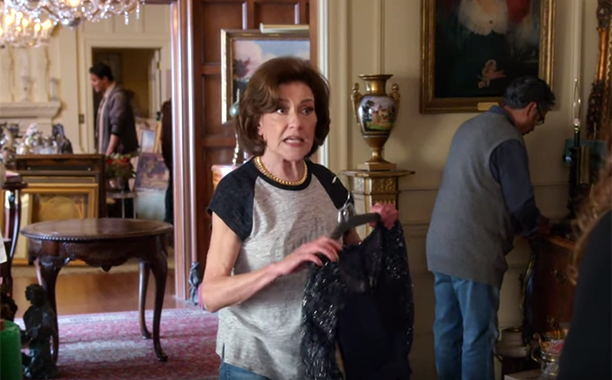
To show how widespread it is, the word KonMari, or her method has been mentioned in popular comedy drama lines. Emily Gilmore in "Gilmore Girls : A Year in the Life" rummages through the piles of her belongings aiming to declutter her life, tells her daughter if she knows Marie Kondo, the Japanese woman.


"Does this bring joy?"
(Feels the dress near her heart.)
"Nope"
(Chucks it away.)


I have seen new kinds of hashtags on social medias since the last entry.

#KonMaried
#Konmari'd
#Konverts

Past tenses were not so popular before, but now there are people showing off the result of the makeover of their shelf or wardrobe or desk on Instagram hashtagged #KonMaried / #Konmari'd.

I also saw a title of an article "The husband was KonMaried..."  Used in a passive (also in a negative nuance though)! This coined word is making a steady growth!

And #Konverts!
It denotes people who are so influenced and devoted to KonMari method.
Now this is really getting religious.

2017年12月29日金曜日

The 12 days of Christmas - 4th and 5th day

So, more on the hidden message in the Christmas song, 'The 12 days of Christmas'.

"On the fourth day of Christmas my true love gave to me
Four calling birds
Three French hens
Two turtle-doves
And a partridge in a pear tree"

Birds again... and they are 'calling birds', sounds like they are singing out.
The four calling birds refer to the four Evangelist, Matthew, Mark, Luke and John, and the Gospels they wrote. They are the first Four Books in the New Testament.

Gospel according to Matthew writes Jesus as King of the Jews, Mark as a servant, Luke as the Son of Man, and John as the Son of God.

The word 'gospel' originally means 'good news'. Imagine birds singing good news of Jesus, good association.

On the fourth day, the Lord reminds you of:
the Four Gospels
faith, hope and love
the Old Testament and the New Testament
and the Jesus on the cross. 

"On the fifth day of Christmas my true love gave to me
Five golden rings
Four calling birds
Three French hens
Two turtle-doves
And a partridge in a pear tree"

Five gold rings! At last, something that is present like!

The five golden ring refers to 'the Pentateuch', the first Five Books of the Old Testament written by Moses - Genesis, Exodus, Leviticus, Numbers and Deuteronomy. It is the history of creation of the world and man, to his fall from grace..... reminder from the Lord of the big mistakes people have made over thousands of years.

So, on the fifth day the Lord reminds you of
the Pentateuch,
the Four Gospels
faith, hope and love,
the Old Testament and the New Testament
and the Jesus on the cross.

The reminder list gets heavier each day...

2017年12月28日木曜日

The 12 days of Christmas - 2nd and 3rd day

What is encrypted in "The 12 days of Christmas" 

So, "my true love" is God almighty, and each day after Christmas he sends messages to the Catholics to remind them of the important teachings of their beliefs.


"On the second day of Christmas my true love gave to me 
Two turtle-doves
And a partridge in a pear tree."


Two turtle-doves mean the Old Testament and the New Testament, two collection books of religious writings. 

The Old Testament is based on the Hebrew bible, and the number of books contained differ between Christian Churches. The Protestant Church Old Testament contains 39 books whereas the Catholic one contains 46. The second part of the Christian Bible, the New Testament contains 27 books.

And also on the second day, the Lord does not forget to remind you also of Jesus on the cross.


"On the third day of Christmas my true love gave to me
Three French hens
Two turtle-doves
And a partridge in a pear tree."

Three French hens refers to "faith, hope and love", the Theological Virtues. It is mentioned in Corinthians 13 : 13 in the New Testament. 

And now these three remain: faith, hope and love. But the greatest of these is love

By the way, the lyrics of the school anthem of my old school was exactly the words from Corinthians 13 - "Though I speak with the tongues of men and of angels..." to "But the greatest of these is love."To me, Corinthians 13 is more a lyrics of the song I used to sing every week at school assemblies than the words of the Bible.

So, on the third day of Christmas, the Lord reminds us of 
faith, hope and love,
and also reminds us again the importance of 
the Old Testament and the New Testament, 
and of Jesus on the cross.

See you next time.

2017年12月25日月曜日

The 12 days of Christmas - an encrypted counting song

Hello. Back blogging again.
Sort of faded off from spring, and through summer and autumn, and now it's Christmas!

So let me blog about one Christmas song that kind of 'haunted' me since childhood, "The 12 days of Christmas".

From Christmas, a person receives a gift from his / her true love every day until Epiphany, and the number of gifts builds up each day. It takes the form of a counting song, but the lyrics never really made sense to me. The gifts that the true love send are genuinely bizarre!

On the first day of Christmas my true love gave to me
A partridge in a pear tree.

On the second day of Christmas my true love gave to me
Two turtledoves
And a partridge in a pear tree

On the third day of Christmas my true love gave to me
Three French hens
Two turtledoves
And a partridge in a pear tree.

On the fourth day of Christmas my true love gave to me
Four calling birds
Three French hens
Two turtledoves
And a partridge in a pear tree.

And it goes on and on and on. So far this person has received 20 birds:
4 partridges in a pear tree, 6 turtledoves, 6 French hens and 4 calling birds (I like to think that the person receives the new gift with the previous ones all over again, it adds more non-sensical fun to the song). This person or the true love must be infatuated with feathered creatures to receive or send so many, not saying any complaint and keep on singing.

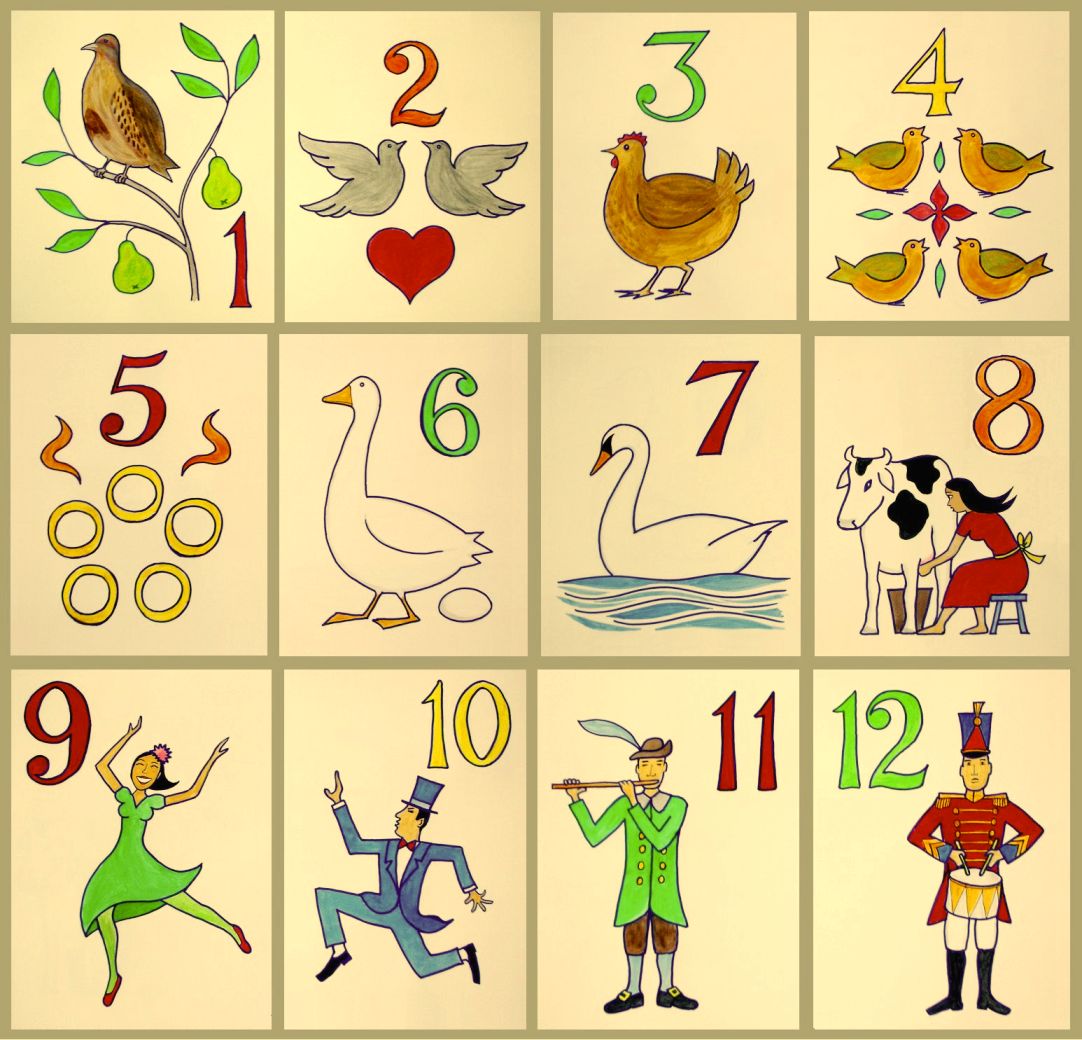
Well, it goes on until the twelfth day, and here is the breakdown of the gifts sent:

On the twelfth day of Christmas my true love gave to me
Twelve drummers drumming
Eleven pipers piping
Ten lords a leaping
Nine ladies dancing
Eight maids a milking
Seven swans are swimming
Six geese are laying
Five golden rings
Four calling birds
Three French hens
Two turtledoves
And a partridge in a pear tree.

The troop is fully armed, ready to make havoc on the twelfth night!

Recently I read somewhere that this innocent nonsense song was an encrypted counting song that started and became popular in England in the 18th century among the persecuted Catholics living under the Protestant society. The lyrics have a double meaning that remind the Catholics the important teachings of their belief.

Now, that is something worth digging into, isn't it?

Because Henry VIII split up with the Roman Catholic Church in order to split up his wives (and for some, to cut off their heads), the Catholics could not practice their belief openly, so they taught the Catholic teachings to their young children through this encrypted song.

"My true love gave to me"
Who is the true love in the Catholic context? God almighty.

God sends you messages every day, reminding you of the important doctrines of the Catholic church.


On the first day of Christmas, that's 25th December, you get "a partridge in a pear tree" which is "Jesus on the cross". God reminds you not to forget about Jesus who sacrificed himself to save us from our sins.

More to come tomorrow!


2017年4月10日月曜日

English's Diversity and Complexity

It's quite interesting that Simon Horobin starts his book How English Became English: A Short History of a Global Language with a reference to an adjective "English" that Samuel Johnson made in 1755:
----------
ENGLISH. adj.
Belonging to England; thence English is the language of England.(Dictionary of the English Language)
----------
By citing Johnson's, his aim is to demonstrate how the concept of "English" has changed over time. Horobin continues:
----------
"Samuel Johnson's straightforward identification of English as the language of England hardly begins to capture the diversity and complexity of the language's use in the twenty-first century."
----------
Johnson's definition "hardly captures the diversity and complexity," the one that is not easy to apply to in our present times. It tells how the meaning of the word changes quite in an unpredictable way. Even the gigantic figure in the field of lexicography would not have doubted English is the language of England!

Perhaps the closer to our sense of "English" is the one that first appears in 1910 according to the OED:
----------
2d. As a count noun: a variety of English used in a particular context or (now esp.) a certain region of the world; (in pl.) regional varieties of English considered together, often in contradistinction to the concept of English as a language with a single standard or correct form.
----------
Doctor Johnson would be surprised to know that English is, above all, "a count noun"!

One would say that the time is pretty much closer to the end when people takes English "as a language with a single standard or correct form," as the OED puts it.

These are the ideas that lead up to the very interesting question posed in "Old English, a different language?

Works cited:

Horobin, Simon. How English Became English: A Short History of a Global Language. Oxford University Press, 2016.

2017年4月8日土曜日

Study of "Sake"

Hidetoshi Nakata, who was one of the worldly-famous football players, has now become a professional “Sake” promoter. After retiring, he began to travel across the world, and it has been years since he launched a journey across the countries of Japan: he is studying and enjoying traditional performance art and craft, especially the ones firmly rooted in each local place.

I respect his global viewpoint and incredible ability to communicate borderlessly with people, as well as his multiple language command. It is this worldwide field of vision and skill that cast his eyes back into the things unique in Japan. In the middle of these local experiences, he finally took a tremendous interest in “Sake,” a Japanese alcoholic drink made from fermented rice.


Joined with a certain company, he contributed to producing a very interesting app named “Sakenomy.” What a fantastic name it is and how outstanding his sense of language is! “Sakenomy,” available to Japanese, Italy, and English, provides information on more than a thousand kind of Sake.

"Sakenomy" is a nice pun. In English, “nomy,” attached to the word ending, forms nouns referring to the science or study of a subject specified by the first element. Ultimately from from Greek, so many lexicons come into a stock of English vocabulary, such as astronomy, economy, taxonomy, gastronomy.

“Nomy” in Japanese means an act of drinking and there is a phrase that sounds exactly like “sakenomy.” The expression often refers to a person who constantly drinks and loves Sake. So this overlapping of both senses is what makes the app really fascinating!

2017年4月6日木曜日

"Shy Man"

----------
A: Thank you for arranging such a party like this today. I really enjoyed it!

B: Did you talk to everybody?

A: Yeah, except one guy who seems so shy. Who was he?

B: Oh, he is a new member to our community. He told me "I am a bit shy in nature so please forgive me if I give a bad impression at first." I think he is just nervous among unfamiliar folks. 

A: I see. Hope he gets used to it soon!

. . . Then time for the check. 

People split the bill and paid their own. The man in question was not able to pay his, because he was also shy with this.
----------

In the nonsense story I made up, I wonder how an adjective "shy" develops into the sense of "lack in the amount of money."

OED defines this "shy" as one of the transferred uses of sense of timidity, recording the first use in 1895, in which the sense of shortage appeared in the context of betting: "to be shy a dollar in the pool"

It's interesting to observe the way the original sense of word develops and transfers in various ways. As for "shy," it's easy to imagine the situation in which "shy" is applied to the sense of "lack" when people, diverting themselves with betting, shout to others "don't be shy! Pool!", out of which the meaning of "shy" becomes common.

2017年3月27日月曜日

Encountering "elf" in yourself

One of the key characters in The Hobbit and Lord of the Rings is Gandalf. He is a wise and erudite wizard, playing a leading role in an adventure of Hobbits throughout the series. This bearded old man played by Ian McKellen also leaves a huge impression on us.

J. R. R. Tolkien, a creator of this Middle-earth sagas, loved stories from Old Norse and got so much influence and inspiration from such ancient mythology and tales. This tells that Gandalf was far from being a fictional figure out of Tolkien's wild imagination: the name was actually recorded in medieval Scandinavian manuscript, showing historical presence of such kind of entity.

“Gandalf” is the word combined with Old Norse (one of the Germanic languages) “gandr” (meaning “wand, staff, cane”) and “alfr” (meaning “elf”), literally meaning “wand elf.” Although they do not belong to any creature on Middle-earth such as elf, dwarf, man, or orc, his name indicates his connection with the elvish race! “Elvish” elements loom so large in the Germanic mythology, and, come to think of it, “alf” is often in the first component of personal names, such as Alfric and Alfred.

Then I embark on finding other hidden presences in daily life.

For example, you often bump into “elves” when you read books: they are on the “shelf.”

Then I realized I have an “elf” much closer to me.

That is “myself.”

I was overjoyed to have met them within me!

There are so many “elves” in a daily landscape. Though the last ones are a mere “pun”, (so the fake etymology), it can suggest that rational creatures (defined based on our modern thinking) are not able to live without the creature of what we usually deem as being "fantastic."

2017年3月11日土曜日

Colorless Green Ideas 02 - an attempt for interpretation

"Colorless green ideas sleep furiously."

Many have attempted to construe some sense out of this nonsensical sentence.  Finding sense in everything is something that humans always try to do. We humans just cannot leave something senseless or "non-categorized". The sentence can come to some understanding if we can make some sense out of the "colorless green" and "sleep furiously". Let's try interpreting it here.

<colorless>
without color or very pale / not interesting

<green>
having the color of grass or the leaves of most plants and trees / not yet ready to eat / young and lacking experience

So "colorless green ideas" can be understood as "monotonous immature ideas".

"Sleep furiously" is a little more difficult to interpret. The agent in the act of sleeping is in an unconscious state, which contradicts with the state of "furiously" where the agent actively and aggressively take part in the action. But how about having  a nightmare? You are sleeping but you are having a frightening experience in your dream, I consider that similar to 'sleeping furiously'.

Colorless green ideas sleep furiously. 
                     ≒ 
Monotonous immature ideas have a nightmare.

Is it now comprehensible?

2017年3月9日木曜日

Colorless Green Ideas 01 - what takes us 'above reality'

"Colorless green ideas sleep furiously".

This is a famous sentence made by the distinguished linguist Noam Chomsky demonstrating the distinction between syntax and semantics. The sentence is grammatically correct but semantically nonsensical. One can read it but cannot derive any meaning or understanding from it.

I first saw this phrase in a text book of linguistics I was reading in graduate school. It is said one cannot derive any understanding from it, but it sort of blew me into the world of "Alice in Wonderland." I like the phrase very much, it is simple, poetic, and me with my wild imagination it is easy to imagine "ideas sleeping furiously". Some might say 'how can green be colorless?' or 'how can you sleep furiously?' and I would just answer, 'Why not?'

This sentence shows that syntax and semantics can operate independently in people's minds, and I think this is how metaphors, poetry and fantasy are born, people have the mind to appreciate them and why there are surrealists. The autonomy of the functions are the source of our creativity, what take the human mind 'above reality'

2017年2月27日月曜日

Muslim Free Hospital

I found an article on Huffington Post about a a very special hospital in Myanmar. It was founded and was funded (and still is) by Muslims in Myanmar in 1937 when the country was still called Burma. The institute provides medical care for the poor people free of charge, and welcomes all people of any religion. As the article says, it is remarkable that the hospital is run so for 80 years considering the status of the Muslims in the country. In Myanmar, the majority of the population is Buddhist, while Muslims are only 4%/.The Buddhist monks openly incite violence to Muslims. The article tells how remarkably the institution is run till today even in such disadvantageous condition. I am awed by the people keep this institution running.

What surprised me linguistically is not the content of the article but the naming of the hospital.


Muslim Free Hospital

I wondered where the word FREE falls on. If it was working like a suffix, Muslim-Free, the institute would turn into a really discriminative one, not accepting any Muslims (look at the definition of the suffix in Roki's article Smoke-free.) And thinking about the proportion and the condition of the Muslims in Myanmar, the possibility of that cynical reading could not be ruled out.

Since there is no hyphen linking Muslim and Free, it can be read 'Free Hospital',  and it must be read like that.

Comma or hyphen could have done a job to make a clearer understanding. Punctuation does matter.

2017年2月23日木曜日

Yakki burger...

When a nation is so called 'advanced' or 'globalized', I find that there are in their cities American based world wide franchised fast food restaurant or two. One of the most successful company is McDonald's. Although it is a global brand, the company allows countries to have latitude in menu, marketing and management to meet the local optimum. One way to enjoy your travel abroad is to go and try the original McDonald's local menu.

In Japan, there are original menus like Teriyaki Burger, Mega Teriyaki Burger, Bacon Potato Pie. Another menu joined the list recently, Shoga-yaki Burger (pork ginger burger). And I was in McDonald's the other day, and found this poster on the wall. Shocking...


To make the product more familiar to people, they have shortened 'Shoga-yaki Burger' to 'YAKKI'. If the person who was producing this product had some senses in English, he wouldn't have given a food menu such a name. It sound exactly like 'yakky', or similar to 'yucky'. If you just read the Japanese it would sound exactly the same as 'yucky'. On the wrapping paper of the burger YAKKI in Japanese character (ヤッキー) is written all over as the design. Yes, what you are about to eat is all wrapped with 'yucky' around it...

yakky
talkative, noisy

yucky
disgusting, very unpleasant, revolting.

In fact, 'yucky' was one of the first English words that I learnt when I started school in Australia, and my classmate's mother was worried about me saying such word.

The sound of the word means something to me so it would take me an effort to enjoy the pure taste of the food. The word gives influence to what I feel... I wonder if anyone has made a complaint on the naming of this product?

2017年2月21日火曜日

Suffragette - Amelioration

Watched a movie called 'Suffragette', starring Carry Mulligan and Helena Bonham Carter, and Meryl Streep making a cameo appearance. It was about women who stood up to fight for their social rights equal to men, set in England in 1912, when the Suffragette movement was at its height.

The characters are fictional, but the historical backgrounds and incedents, the movement of the suffragettes are faithful to what is recorded in the history. I enjoyed the movie very much, and it was hard to believe that all this happened only a hundred years ago, but was not told in detail until recently.

My first encounter with the word 'suffragette' was in the musical movie 'Mary Poppins'. The mother of the family is a suffragette, and she goes to rallies and demonstrations, all secret to her husband. She sings a number in the movie 'Sister Suffragette'. It is a delightfully cheerful song, and my impression towards the word 'suffragette' remained very neutral.

However, the movie 'Suffragette' changed my impression completely. Women were fighters, soldiers, and they had pride to be a suffragette.

The term 'suffragette' was first made and used in Daily Mail in 1906, when the suffragette movement started to become more intense and active. The etymology of the word mentioned in the OED is as below.

suffragette
etymology
SUFFRAGE (n) + ETTE (suffix)
A female supporter of the cause of women's political enfranchisement, especially one of a violent or a 'militant' type.

What interests me is the suffix -ETTE. It is a diminutive suffix. It also does refer to something feminine, but I suspect that the newspaper made the word 'suffragette' with the diminutive tone in it.
'OK, the ladies are trying hard and fighting for their rights, aren't they? Let us see how well they can do it without the help of us men...'
kind of tone.

In early 20th century widely read literary and scientific periodical 'Anthenaeum', the word is clearly used in a diminutive, negative tone.

1907 Athenaeum 28 Sept 358/2
[Aristophanes] who represented Cleon, as noisy, Euripides as sentimental, Socrates as pedantic, and women as 'suffragettes'

The word may have started with a negative tone, but watching the movie 'Suffragette', it was used not negatively but powerfully, full of pride and vigor.

This seems an opposite process to pejoration that the word had undergone - it started as negative, but gained positive, if not, neutral tone. This process is called 'amelioration'.

Like women who fought to earn their rights, the word that represented them also earned its present status.

2017年2月4日土曜日

Some Notes on "Often" 1

The pronunciation of “often” serves as one measure to know to which English accent, British or American, the English learners/speakers are inclined: If you pronounce “t,” it’s more like British, and if you don’t, it can be from natives of American English. I often ask students which, and fewer of them pronounce “t.”

I remember I was too taught NOT to pronounce “t” when I was a junior high school student. But after having stayed in Australia and communicated with lovely Aussie, I became a man of “t” side (I was "naughty" during the stay though) Or, as I recall, my “t” accent might have come from a constant exposure to, and desire to copy, the speech of my favorite British actor Rowan Atkinson, who clearly pronounce the word.

In 1926, Fowler noted that pronunciation of “t”

“is practiced by two oddly assorted classes―the academic speakers who affect a more precise enunciation than their neighbours . . . & the uneasy half-literates who like to prove that they can spell by calling hour . . . howr”.

It is interesting that around the time of this remark, “t” pronunciation was associated with affected behavior among academics. Is it possible to speculate that the present pronunciation “t” has its origin in the posh society, which permeates into people of pretentious motives?

To be continued.

-------
Butterfield, Jeremy. ed. Fowler's Dictionary of Modern English Usage. 4th ed.Oxford Clarendon, 2015.

2017年2月3日金曜日

Yahoo! Attempted Genericide

It was not only Bing that attempted genericide. I found this movie on YouTube which campaigns Yahoo's search engine. The title of the commercial, and the final catch phrase is

'Do you Yahoo?'


It clearly uses the trademark in verb form.

Fortunately, it is only attempted genericide.
The trademark is still well and thriving, though it does not line up to top Google...

2017年2月2日木曜日

The Trojan "Brand" 2

Here is a follow-up to The Trojan "Brand" 1.

For Japanese, the word “brand” calls up a costly image. It is “a brand name,” a type of product manufactured by a particular company under a particular name. Japanese tend to associate the word with fashion goods of high quality, such as Hermes and Louis Vuitton.


A bit of a surprise that this is the same brand as "brands and ashes"!

Originally, the mark made by burning iron is a sign of infamy, indicating a mark of someone’s ownership or trademark. From this, though initially negative, the word seems to have developed the more familiar meaning, at least among Japanese, “a particular sort or class of goods, as indicated by the trademarks on them.” (OED, s. v. “brand,” n. 6), first recorded around the middle of the 19th century.

It is interesting that the English dictionary does not give a sense of high class to "brand" itself. This means the implication attached to the word is peculiar to Japanese. What we call “brand” item gives an air of extravagance, usually pointing to luxurious items normally available to wealthy people. I suppose that the semantic gap is a reflection of Japanese attitude towards western culture, but it is worth further research.

Japanese usage of "brand" is far removed from the original sense the word carried. With its drastic change of connotation, they enjoy basking themselves in the Trojan "brand" in a different way.

2017年2月1日水曜日

Bing! Attempted genericide

For Google it is a serious matter that its trademark is on the verge of generification, that it might lose its power as a trademark and become a general verb. The word Google has almost become a synonym 'to search something on the Internet using a search engine'.

For the rival company, Google's popularity is something that they envy and want. Bing is also a search engine like Google, but like Coke and Pepsi rivalry, Bing is a little behind in history for it to compete with Google the great. However, the CEO of the company Steve Ballmer has mentioned in an interview in New York Times in 2009 that he sees potential in the trademark 'to verb up.'

The phrase "Bing it!" has been used in an episode in Hawaii Five-O series, but it did sound a little odd there.


Bing's attempt to gain popularity is the same as risking the life of a trademark -  it's an attempted genericide. Fortunately or unfortunately, it has not verb-ed up yet like Google.

"Bing it"

2017年1月31日火曜日

The Trojan "Brand" 1

Reading the medieval text is an opportunity to encounter the words whose senses are different from, or quite opposite to, what they are now. It often makes me wonder how the semantic gap was born throughout history. Here is the beginning of some Arthurian literary poem:

     SIÞEN þe sege and þe assaut watz sesed at Troye,
     Þe borȝ brittened and brent to brondeȝ and askez,

     (When the siege and the assault had ceased at Troy,
     And the fortress fell in flame to brands and ashes...)

Then it follows how the Trojan survivors explored westwards and became an ancestor of the most European countries, finally reaching Britain (named after Brutus, a grandson or great grandson of Virgil’s Aeneas). The story of Troy was extremely popular in the Middle Ages and a claim of its lineage empowered aristocrats. (see Brutus and Britain and Eponym of Britain)

As the passage shows, the story of Troy serves as a kind of prologue to the Arthurian dynasty that ensues. Interestingly, it is a story of rebirth from “brands and ashes,” a destruction caused by the Greek. "Brand", or devastation of Troy, was not an end but an impetus in creating new nations. Thus, a sense of their identity was boosted by, so to speak, the Trojan "brand."

The Trojan "brand"?

“Brand” is an interesting word here from the viewpoint of semantic change. Here “brand” means a piece of burning or smouldering wood, referring to the state of devastation and wilderness. It has a negative sense such as “an identifying mark burned on livestock or criminals or slaves with a branding iron.” It is a mark of stigma and disgrace. When used as a verb, it is usually used in a negative context like “they have branded him as an imposter.”

To be continued.